3.3.22

February 2022: Factory Activity Grows


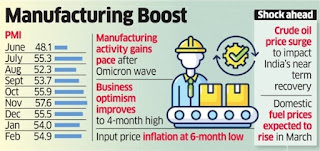
India’s manufacturing sector activity bounced back in February buoyed by an accelerated pace of new orders supported by favourable demand conditions and higher production.

The IHS Markit India Manufacturing Purchasing Managers’ Index rose to 54. 9 in February from 54 in January. A reading above 50 on the index shows expansion and below that indicates contraction.

The February PMI data pointed to an improvement in overall operating conditions for the eighth straight month

“Growth has now been seen in each of the latest eight months, with the headline figure remaining above its long-run average of 53. 6,” IHS Markit said in a report.

Shreeya Patel, economist at IHS Markit said the Indian manufacturing sector had “weathered the storm” of the Omicron-variant-led third wave.

As per the report, rates of expansion picked up at intermediate and capital goods firms but eased for consumer goods makers. Demand from international clients rose at the quickest pace in three months but employment decreased in February.

Rahul Bajoria, Chief India Economist at Barclays said that the surge in crude oil prices casts a long shadow on India’s recovery in the near term. 

Purchase price inflation was sharp, but softened to a six-month low, according to the report. As for business sentiment, IHS Markit said that an improvement was seen midway through the quarter, underpinned by business expansion plans, a return to normality and hopes for fruitful marketing. The degree of optimism remained below its long-run average, however.

Crude Climbs Above $110

Oil prices topped $110 in the aftermath of western sanctions that are driving away financiers and traders from Russian oil and creating global supply worries.

Crude oil futures touched $113 per barrel during the day, the highest since July 2014, as the market ignored the decision by key consumers to release 60 million barrels of oil from their emergency reserves, or 2 million barrels a day for 30 days, to meet any shortfall emerging from Russian supply curbs. Withcrude exports of about 5 million barrels per day, Russia is the second-largest oil exporter after Saudi Arabia. While wester n sanctions haven’t directly targeted the energy sector, markets are expecting banking restrictions to strangle energy supplies at a time OPEC+, the producer club led by Saudi Arabia and Russia, is unwilling as well as unable to raise output significantly.

Unprecedented sanctions have deepened uncertainties for the global economy as well as for India.

India depends on imports for 85% of its oil needs and is recovering from the pandemic induced economic recession.

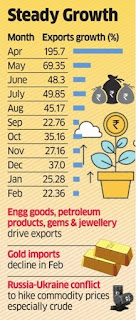
February 2022 : Exports rise 22%


India’s exports went up 22. 4% to $33. 8 billion in February, while a faster rise in imports resulted in a widening of the trade deficit.

Latest data released by the commerce department pegged imports at $55 billion in February, 35% higher than the corresponding period last year, on account of higher oil and gold prices. As a result, the trade deficit was estimated at $21. 2 billion in February compared with $13. 1 billion a year ago.

The numbers mean that India’s exports during April-February were nearly 46% higher at Rs 374 billion, against a target of $400 billion for the current financial year.

“With monthly exports crossing the $30-billion mark for the 11th consecutive time during the fiscal, we are on course to cross the $400-billion exports target for the fiscal,” said A Sakthivel, president of industry lobby group FIEO. 

Higher commodity prices are seen to be one of the reasons for the growth along with higher demand for several products.

2.3.22

Core Sector Growth Slows Down to 3.7% in January


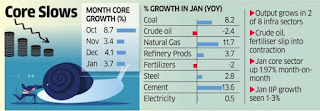
The core sector output grew 3.7% in January, lower than 4.1% in the previous month, pulled down by natural gas, refinery, fertiliser and electricity.

The core sector had grown 1.3% in January 2021. The Omicron wave had impacted economic activity in the month after several states imposed restrictions to curb the spread. The core sector index measures the output of eight infrastructure sectors—coal, steel, cement, fertiliser, electricity, natural gas, refinery products and crude oil. 

Six of the eight sectors — coal (8.2%), natural gas (11.7%), refinery products (3.7%), steel (2.8%), cement (13.6%) and electricity (0.5%) — reported growth in the month. Crude oil and fertiliser production shrank 2.4% and 2% respectively in January. In the first 10 months of the current fiscal, the core sector has grown 11.6% compared with 8.6% contraction in the year-ago period.

On the positive side, compared with pre-Covid (February 2020) levels, output of all the core sectors was higher in January 2022. While this reflects the resilience of the infrastructure industries to the Covid-related disruption, the global recovery faces fresh headwinds due to the Russia-Ukraine conflict, said Sunil Kumar Sinha, principal economist, India Ratings and Research.


MMRDA: Crucial infrastructure works to begin


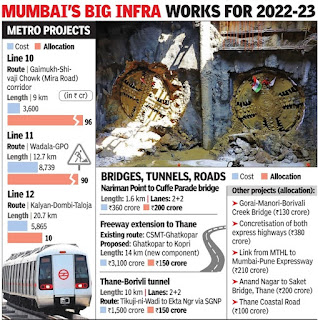
Crucial infrastructure works, including an underground Metro corridor between Wadala and CSMT, the extension of the Eastern Freeway till Thane, and the construction of a Coastal Road link between Nariman Point and Cuffe Parade are likely to begin this year. The Mumbai Metropolitan Region Development Authority has sanctioned substantial amounts for these projects in its Rs 18,404-crore budget for the 2022-23 financial year.

MMRDA undertakes works on the city’s Metro corridors and road expansion projects, besides developing crucial infrastructure in the Mumbai Metropolitan Region, which includes the districts of Mumbai, Thane and Raigad. The current budget was approved at the 152nd authority meeting chaired by urban development minster Eknath Shinde.

Metropolitan Commissioner SVR Srinivas said, “We have presented a budget with a deficit of Rs 7,680 crore. The expenditure proposed is Rs 18,404 crore as against revenue estimated at Rs 10,724 crore. ”

The shortfall will be met by borrowing through loans, revenue by leasing of land parcels, development charges, and income from Metro projects to be commissioned this year. Srinivas said, “This budget mainly emphasizes implementation of public transport and vital infrastructural projects, for which Rs 2,111 crore has been earmarked. ” (See graphic for projects. ) He said, “We hope to complete the tender process for the three Metro corridors in six months. Metro 11 will have integration with Metro 4 (Thane-Ghatkopar-Wadala). ”

The Detailed Project Report for the extension of Eastern Freeway till Thane is being prepared. MMRDA estimates that it will be able to finalise the DPRs and bids by August 2022. The DPR for the construction of a sea-bridge between Cuffe Parade and Nariman Point has been prepared and soon MMRDA will float tenders for which Rs 260 crore has been sanctioned in the budget.

GDP growth in Q3 slows to 5.4%

The Indian economy is estimated to grow marginally slower in the current fiscal year that ends in March than forecasts showed earlier as the impact of the pandemic hurt expansion while rising inflationary pressures and the effects of the war in Ukraine are likely to hurt ongoing economic recovery in the months ahead.

The economy is estimated to grow by 8.9% in 2021-22, slower than the previous forecast of 9.2%. The economy had contracted by 6.6% in the previous year as the pandemic took a toll on growth. The 8.9% estimated growth for 2021-22 will help the country maintain its status as the fastest growing major economy in the world.

Growth in the three months to December slowed to 5.4% from 8.5% in the second quarter and 20.3% in the first quarter.

The NSO data showed that the economy slowed in the October-December quarter of 2021 as the base effect waned and the impact of the coronavirus-induced curbs weighed on expansion.

Slowing manufacturing and construction weighed on growth while the services sector, which accounts for over 50% of the country’s GDP remained steady.

Trade, hotels, transport, communication and services related to broadcasting were the only sectors which remained sluggish. According to SBI Research the third quarter absolute numbers of these sectors are still 95% lower than the pre-pandemic level (Q3 FY20).

“Private consumption is below the pre-pandemic level and this is largely because labour intensive sectors such as trading and construction have not recovered from the pandemic shock. The recovery in these sectors remains patchy,” said Soumya Kanti Ghosh, group chief economic adviser at State Bank of India.

HDFC Bank said that the performance of private consumption expenditure for the full year was a positive trend. Growth has been revised up to 7.6% in FY22 from the earlier advance estimate of 4.1%, signalling faster recovery in consumer spending than earlier anticipated.

Mystery monolith in MP is world’s biggest Nataraja statue


A monolith rock sculpture in Madhya Pradesh’s Vidisha district has turned out to be one of the biggest statues of Lord Shiva, around 1,500 years old, which was mysteriously left on the ground instead of being put upright.

Shiva statues come in many forms, and this is believed to be the world’s biggest Nataraja sculpture. A day before Mahashivratri, state convener of Intach Madan Mohan Upadhyay said on Monday, “It is the largest Nataraja sculpture in the world. The ruins have great potential of turning into a national and international tourist destination. ”

Intach has completed documentation of the ancient site — 140 km from Bhopal — and will submit a report, said Upadhyay.

The Vidisha district administration, Madhya Pradesh tourism department and state archaeological department are also working on measures to conserve this rich heritage.

The massive sculpture, 9m-long and 4m-wide, was created out of a single rock. It’s so big that its image could never be captured in one frame until Intach used a drone, which revealed for the first time that it is a dancing Shiva, he said.

For the past year or so, Intach has been working at the site of Udaipur, a city created by Parmar king Udayayditya, around 1059 AD. The Nataraja sculpture predates these ruins.

The village and associated infrastructure of palaces, temples, water bodies, bastions, fortification wall and the gates to the city and innumerable monuments speak volumes about Udaipur, Upadhyay said.

The place is known all over Madhya Pradesh for the Neelkantheshwar Mahadev temple, an ASI protected monument that attracts a large number of tourists, especially on Maha Shivratri. The story of the creation of this place along with the Neelkantheshwar temple of Lord Shiva is written in the inscriptions, which are now preserved in the Gwalior museum.