4.2.22

Delhi: Chandni Chowk Revamp II With Jama Masjid In Focus

In the second phase of the Chandni Chowk redevelopment plan, the Public Works Department is working on a design that will be synchronous with the iconic Jama Masjid. The department is planning to make the area around Jama Masjid pedestrian only, like it was done with the main road in the first phase of the redevelopment. The architecture will be in the style of the mosque.

“We have asked the consultant company to work on a couple of points. The plan is divided into four areas. We are working on amalgamation of Mughal architecture with red sandstone in the second phase to give the area a renewed look. The earlier corridor that was beautified looks similar to Red Fort,” said a PWD official.

As part of the second phase of the project, the department is working on facade improvement, redevelopment of internal roads, beautification of the area around Jama Masjid and pedestrianisation of the stretch between Delhi Gate and Kashmere Gate. “This phase will have different challenges as the internal roads are narrow. The area around Jama Masjid may also be pedestrianised like the main road,” the official said.

After redevelopment of the main road in Chandni Chowk, PWD would be redeveloping Netaji Subhash Marg from Delhi Gate to Kashmere Gate. The company has been given nine months to complete the survey, after which it will submit the plan to deal with encroachments, bus shelters and cost of construction.

The Shahjahanabad Redevelopment Corporation is working along with PWD to redevelop this heritage area and cultural centre in the Walled City. There will be a dedicated non-motorised vehicle zone on Netaji Subhash Marg and signboards and bollards will be installed at various places. Starting from Netaji Subhash Marg near Red Fort, beautification work will be undertaken on the stretch from Old Delhi Railway Station to Church Mission Road. To provide parking facilities to traders and visitors, North Delhi Municipal Corporation is also constructing a mega multi-level parking at Dangal Maidan. The revamped 1. 3km stretch of Chandni Chowk was inaugurated last year by chief minister Arvind Kejriwal. It was paved with red extending from Red Fort to Fatehpuri Masjid. While benches and plants adorn the remakes navigation easy. CCTV cameras have been installed in the area to ensure safety. The stretch was also made a non-motorised traffic zone between 9am and 9pm.

Galwan Decoded

China lost at least 38 soldiers during the violent Galwan clashes with India in June 2020, which is much more than the five casualties Beijing has officially acknowledged till now, an Australian website has claimed. The Indian Army has for long maintained the death toll among the ranks in the People’s Liberation Army was “much higher” than what China admitted to after a long delay.

India had immediately announced that 20 of its soldiers led by Col B Santosh Babu had laid down their lives while fighting the numerically superior Chinese troops, armed with nail-studded rods and other sharp weapons, during the extended clashes on June 15-16 that year.

The then Northern Command chief, Lt Gen Y K Joshi, for instance, had said that Indian observation posts “picked up a large number of PLA casualties” that were being taken back in stretchers. “More than 60, actually. But whether they were fatal or non-fatal, we can’t say with authority,” he had said.

As per the Australian website, the Klaxon, which based its report on a detailed study done by a group of unnamed social media researchers whose sources included Chinese bloggers and others, at least 38 PLA soldiers drowned while attempting to cross the Galwan river in the early stages of the clash amid sub-zero temperatures in darkness . Quoting a report, “Galwan Decoded”, by the group of social media researchers, the website said, “Comrades in arms kept slipping and being rushed downstream… After the incident, the bodies were first taken to Shiquanhe Martyr Cemetery, followed by local ceremonies at the local towns of the killed soldiers.”

The website said the PLA had not adhered to its promise to dismantle the infrastructure it had created in the buffer zone area. Instead, it dismantled a temporary bridge constructed by the Indian Army.

3.2.22

RBI’s digital rupee will revolutionise fintech: PM

PM Narendra Modi made a strong pitch for the digital currency to be launched by RBI, saying the digital rupee as proposed in the Union Budget could be exchanged for cash and will open new opportunities in the fintech sector.

“The digital rupee will revolutionise the fintech sector by creating new opportunities and lessen the burden in handling, printing, logistics management of cash. The Central Bank Digital Currency will be the digital form of our physical rupee and will be regulated by RBI. This will be such a system that will enable exchange of physical currency with digital currency. It will strengthen the digital economy. . . If anyone makes payment in digital currency, you will be able to change it to cash,” he said.

Modi’s remarks at a virtual symposium “Atmanirbhar Arthavyavastha (self-reliant economy)”, which was attended by BJP chief J P Nadda and other senior party functionaries, chief ministers of BJP-governed states and elected members, marked a full-scale embrace of the digital currency that seemed to contrast with the cautious ambivalence the government had shown so far on the issue.

Modi was forthright as he mentioned digital currency’s potential benefits. “CBDC will make digital payments and online transfers of funds more secure and risk-free. This will lead to ease in development of global digital payment systems,” he said, his remarks providing the maiden peek into the government’s posture on the sensitive issue of how to deal with digital currency.

2.2.22

E-bank for all pin codes

A large chunk of the Indian population will bridge the digital divide in the current financial year with post offices putting in place a core banking system and banks setting up digital banking units in 75 districts.

The Post Office Savings Bank has 19 crore savings accounts including those under the Mahatma Gandhi National Rural Employment Guarantee Act. While the post office has the reach, its customers do not have access to anytime-anywhere banking, which is available to the urban clientele.

With all the 1. 5 lakh post offices in the country coming under the core banking system, customers can access their accounts through net banking, mobile banking, and ATMs. They will also be able to transfer funds from their post office accounts to accounts in commercial banks.

“The Budget proposal to set up 75 DBUs in 75 districts is in sync with our ongoing digital banking initiatives,” said SBI chairman Dinesh Khara.

“For India to become a digital economy, all villages should have the same access to digital resources as urban areas. To augment this, the setting up of DBUs is a commitment to taking high-end tech to the bottom of the pyramid,” said Anand Kumar Bajaj, Founder, MD & CEO, PayNearby.

According to bankers, the setting up of DBUs will provide a concerted effort at building up a payment ecosystem that will benefit all the banks in the district. “The Jan Dhan Yojana has ensured that most households have bank accounts. The need now is to build an ecosystem so that they can use their accounts for all transactions without having to draw cash,” said a senior banker. He added that the details of the scheme were still awaited.

According to Bajaj, DBUs will ensure that the benefits of digital banking reach every nook and corner of the country in a consumer-friendly manner. “The objective of citizen empowerment with digital growth and supporting fintech will directionally encourage delivering of digitisation to India in its 100th year well ahead of time,” said Bajaj.

1.2.22

Tatas bag PSU steel co Neelachal


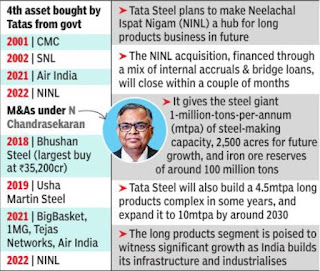
Tata Steel will take control of Neelachal Ispat Nigam after bidding Rs.12,100 crore, including equity and debt, the government said on Monday. The unit of Tata Sons plans to make Neelachal’s Odisha facility, currently defunct, the hub for its long steel business in the future. Long steel products refer to rods, rails and bars used in the construction sector.

The deal comes hot on the heels of Tata Sons acquiring Air India from the government through the privatisation process. The M&A is in line with Tata Steel’s strategy of doubling down on the India business after selling some unprofitable overseas ventures. In 2018, it had acquired Bhushan Steel for Rs 35,200 crore, the largest M&A under Tata Steel chairman N Chandrasekaran (who is also the chairman of Tata Sons) — the first India consolidation move as part of that strategy.

On Monday, the government said it has approved the highest bid of Tata Steel Long Products, a unit of the $21-billion Tata Steel, for a 94% stake in the loss-making Neelachal at an enterprise value of Rs 12,100 crore. Besides Tata Steel, billionaire industrialist Sajjan Jindal-controlled JSW Steel and a grouping of Jindal Steel & Power (owned by Sajjan’s younger brother Naveen Jindal) and Nalwa Steel & Power submitted financial bids for Neelachal.

Tata Steel will have to pay 10% of the bid amount when it signs the share purchase agreement. Neelachal’s debt exceeded Rs 6,600 crore, while its accumulated losses was Rs 4,228 crore as on March 31, 2021. This is the first instance of privatisation of a public sector steel manufacturing enterprise in India.

Eco shrank 6.6% in FY21

India’s economy contracted by 6.6% in 2020-21, narrower than the earlier estimate of 7.3% decline, highlighting that the economic damage inflicted by one of the strictest lockdowns in the world to ward off spread of coronavirus was less severe than estimated earlier.

Data released by the National Statistical Office on Monday also showed that the economic slowdown was sharper at 3. 7% expansion compared to the earlier estimate of 4% growth for 2019-20.

The use of latest available data from various agencies has resulted in some changes in both the levels of GVA and growth estimates for 2018-19 and 2019-20, the NSO said. The 7.3% contraction was the sharpest in nearly four decades as the Covid-19 induced lockdown had hurt the economy. But the revised data seems to show that the damage was lower than what was expected. The lockdown had hurt several key sectors of the economy, particularly the contact intensive sectors, such as tourism, hospitality, aviation and others.

The agriculture sector has been the mainstay of the economic revival, that has taken place after lifting of curbs. The sharp contraction had triggered a debate over the management of the economy and impact of lockdown.

Production of eight infrastructure sectors expanded by 3.8% in December 2021 against a 0.4% contraction in the same month last year on better show by coal, cement and refinery products, according to the official data released on Monday.

BKC: Bees Saal Baad


Looking at a satellite image of Bandra Kurla Complex today, it is difficult to imagine that 20 years ago, after reclamation, it was mostly vacant. Land was available there at a throwaway price of Rs 3,000 per square metre, or Rs 300 per square feet in the 1980’s. As the 90s approached, prices at BKC inched up to Rs 8,000 per sq metre. Liberalisation transformed the scene overnight. The last land auction at BKC occurred towards the end of the noughties. By then, prices had shot up to almost Rs 3. 5 lakh per sq metre. To meet demand, MMRDA increased BKC’s FSI from 2 to 4 for commercial plots and from 1. 5 to 3 for residential plots.