8.2.22

IGIA: New Arrival Terminal 1


The new arrival terminal at Indira Gandhi International Airport is ready and will become operational soon. Officials said the 8,000 sq metre facility at Terminal 1 would offer a distinctive experience to flyers and the current domestic arrival operations will move to the new arrival terminal.

The new arrival facility is equipped with four additional baggage carousels. The pickup lanes outside the terminal have been realigned and expanded by three to a total of 11 lanes. This will ease traffic congestion and significantly boost convenience for passengers.

Among other features at the new facility are modern toilets, huge space between baggage belts, greenery inside the terminal with ample natural light, lavish ceremonial and VIP lounge, state-of-the-art meet and greet gallery, modern food court and ample parking space for taxis, cabs, private vehicles and shuttle buses.

As part of IGIA’s Phase 3A expansion project, the integrated Terminal 1, where work is under way, will have the arrival and departure terminals under one roof. The upgraded T1 will double its passenger handling capacity from 20 million to 40 million passengers per annum. After completion, the new Terminal 1 will have integrated arrival and departure terminals, a new node housing retail and F&B outlets and a pier building comprising 22 contact stands.

An airport official said T1’s arrival terminal will become operational soon, but the integrated T1 will take some time to become functional. Expansion projects under Phase 3A will help IGIA to become future-ready, as the airport’s three terminals will enhance passenger capacity to 100 million passengers per annum, while the airside capacity will rise to 140 million passengers annually.

As part of the overall development plan under Phase 3A, DIAL has constructed the new and expanded T1 apron, IGIA’s fourth runway, the dual elevated eastern cross taxiways to connect the northern and southern airfields, landside developments for circulation and connectivity improvements and T3 modification works.

January 2022: Motown musings


Retail of automobiles sales continued on a downward clip as semiconductor shortage and poor rural sentiment impacted demand, but vehicle retailers remain hopeful of an improvement in the coming months.

Registration of vehicles with regional transport offices, which is a good proxy for retail sales, declined by 11% year-on-year in January. Registrations were down 18% compared to the pre-Covid month of January 2020, as per data from the road transport and highways ministry's VAHAN platform.

Two-wheelers remained the category under maximum pressure with the rural economy being in disarray. Meanwhile, passenger vehicle or car sales took a hit due to poor availability of semiconductor chips despite robust consumer demand. Commercial vehicle and three-wheeler registrations grew year-on-year, however, on an exceptionally low base. Compared to the pre-pandemic period, both categories remained in the red.

Data were compiled by the Federation of Automobile Dealers’ Associations, a lobby of vehicle retailers. The data is incomplete as only 1,379 out of 1,590 RTOs in the country are on the VAHAN platform. But they paint an accurate picture in terms of trends.

The budget announcement by Finance Minister Nirmala Sitharaman to construct 25,000 kilometres of highways in FY23 and other infrastructure spending augurs well for CV sales. Meanwhile, the government’s plan for increasing rural spending may help two-wheeler, tractor and entry-level car sales.

The average inventory with car dealers was about 8-10 days’ worth at the end of January compared to the industry norm of holding a month of inventory. Two-wheeler dealers had 25-30 days of inventory on average, a FADA survey found.

‘Quantum Tech can Add $310b to Economy by 2030

The adoption of quantum technologies across industries can potentially add $280–$310 billion of value to the Indian economy by 2030, IT industry body Nasscom said in a report.

The uptake by enterprises is also expected to go up by 45% and in India, sectors such as manufacturing, hightech, banking, and defence will likely lead the charge of adopting quantum technologies for critical and largescale use cases.

The quantum ecosystem in India is growing at an accelerated pace with 10-15 government agencies, 20-30 service providers, 1520 startups and 4050 academic institutions active in this domain, said senior industry officials.

A number of government agencies, academic institutions as well as startups have built commercially viable quantum computing use cases, Achyuta Ghosh, research head, Nasscom said.

“We see companies like Tata Consultancy Services, HCL Technologies, Infosys, Tech Mahindra, Zensar, Mphasis, Coforge among others creating use cases for quantum technologies and proof of concept for clients,” Ghosh said. There is likely to be acceptance from service providers also very soon, he added.

Of around 100 projects initiated in quantum in India, about 92% are government sponsored.

During the 2020 budget, an outlay of ₹8,000 crore ($1 billion) was announced for the next five years to advance progress in quantum information and meteorology, quantum applications and materials, and quantum communications.

“Today, we have less than 200 people in this industry across startups, academia and government but there is a massive need to scale it up to 25,000 as envisioned by the government in order to tap the $310 billion opportunity it offers over the next decade,” Ghosh said.

The actual growth will, however, come from enterprise adoption, said Akshay Khanna, managing partner, Avasant, a technology advisory firm that partnered with Nasscom on the report.

“The growth of cloud hyperscalers is also making quantum technology more accessible on the cloud. In India, enterprise adoption of quantum computing technology stands at around 1-2%. We see this going up to 35-45% over a decade,” Khanna said

GAY : ‘Offensive’ code for Gaya airport

A parliamentary panel has found GAY — the International Air Transport Association code for Gaya airport — “inappropriate, unsuitable, offensive/ embarrassing”, and has asked the government to get it changed to YAG or some other suitable alternative.

IATA, which assigns airport codes that can be seen while booking tickets, represents about 290 airlines in 120 countries carrying 83% of the world’s air traffic. Member airline Air India had flagged the agency about the “inappropriate” code for the holy city in Bihar, but the international agency “expressed its inability to change” it.

Last January, the Committee on Public Undertakings in its first report tabled in Parliament recommended a change because “locals might find it offensive or embarrassing” that their city is “recognised in the international community with the code name GAY”. It also found it “inappropriate”.


7.2.22

Khwaja gave message of humanity: PM

On the occasion of the 810th Urs of Khwaja Moinuddin Chishti, PM Narendra Modi greeted his followers and paid homage saying the “great Sufi saint gave the message of humanity to the entire world”.

In his written message, the PM said “unity in diversity is the identity of India” and “harmonious co-existence of various sects, communities and beliefs in the country is our strength”.

Minority affairs minister Mukhtar Abbas Naqvi offered a‘chadar’ at the Ajmer Sharif Dargah on behalf of the PM and read out his message conveying his greetings on the occasion. “Congratulations and warm wishes to followers of Khwaja Moinuddin Chishti across the world on his 810th Urs. By offering ‘chadar’ to Ajmer Sharif, I pay homage to the great Sufi saint, who gave the message of humanity to the entire world,” the PM said.

Modi further stated that “the great saints, mahatmas, pirs and fakirs have played a pivotal role in strengthening the socio-cultural fabric of the country in different periods. In this glorious tradition, the name of Khwaja Moinuddin Chishti, who gave the message of love and harmony to the society, is taken with full respect and reverence”.

“The philosophy and principles of Garib Nawaz will continue to inspire the generations to come. Urs, the symbol of harmony and brotherhood, will further strengthen the faith of the devotees. With this belief, on the occasion of annual Urs of Khwaja Moinuddin Chishti at Dargah Ajmer Sharif, I pray for the country’s happiness and prosperity,” the PM said.

Naqvi said that the life of Gharib Nawaz inspires us to strengthen the commitment to communal and social harmony. “This unity can defeat the forces, who are engaged in the conspiracy to create divide and conflict in society,” he added.


India’s nightingale Lata Mangeshkar cremated with full state honours


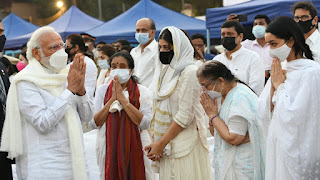
The nation was mourning, social media was brimming with emotions and a sea of teary fans bid adieu to Lata Mangeshkar. Her funeral pyre was lit by Hridaynath Mangeshkar. The legend breathed her last at the age of 92 at the Breach Candy Hospital in Mumbai on February 6. She was cremated at Shivaji Park in Mumbai, in the presence of fans, family, celebrities and politicians. She was cremated with full state honours. The Government of India also announced two days of State morning as a mark of respect. During State mourning, the National Flag will be flown at half-mast from Feb 6 to 7 throughout India.

PM Narendra Modi arrived from Delhi to attend Lata Mangeshkar’s funeral. Shah Rukh Khan, Sachin Tendulkar, Ranbir Kapoor, Shankar Mahadevan, Javed Akhtar and several others paid their last respects to the legend at Shivaji Park. Lata Mangeshkar was diagnosed with Covid-19 and pneumonia in January. Her health briefly improved but on February 5, her condition deteriorated. Dr Pratit Samdani shared the sad news of Lata Mangeshkar’s demise and said, “It is with profound grief that we announce the demise of Lata Mangeshkar at 8:12am. She has died because of multi-organ failure after more than 28 days of hospitalisation post #COVID19.”

In a glorious career spanning seven decades, Lata Mangeshkar sang over 30,000 songs in different languages. She was the oldest of the siblings, Meena Khadikar, Asha Bhosle, Usha Mangeshkar and Hridaynath Mangeshkar.

5.2.22

RBI's CBDC

What is a central bank digital currency?

Digital currency may seem like a new concept, but if you use cards, netbanking or payment apps like Paytm and Google Pay, you are already part of the movement towards cashless transactions that it is designed to strengthen. CBDCs, though, are about more than just cashless transactions and could end up transforming the banking system.

The biggest nudge to governments’ digital currency push has come from the rise of cryptocurrencies like Bitcoin and Ether that have prompted speculation about the future of fiat currency – that is, currency backed by governments – as they claim to do most of the work of the modern banking system more swiftly and at a fraction of the cost.

How is CBDC different from cryptocurrency?

Although they are called ‘cryptocurrency’, Bitcoin, etc, are not currency but digital assets. They are privately issued and are not backed by any sort of authority, government or otherwise. But a fiat currency, such as the US dollar or the Indian rupee, is backed by a central bank, which guarantees its value. 

CBDCs would be the electronic version of the physical currency and not a new currency altogether. According to RBI deputy governor T Rabi Sankar, it would represent “legal tender issued by a central bank in a digital form”.

Where cryptocurrencies and CBDCs could overlap would be in the technology on which they are based, with finance minister Nirmala Sitharaman saying in her Budget 2022 speech that the RBI CBDC would use “blockchain and other technologies”.

Blockchain is a kind of distributed ledger where the record of every transaction involving the cryptocurrency is maintained by every single device on which it is stored. It does away with the need for a central authority to validate each and every transaction.

Advantages of CBDCs

At present, cash is the only money issued by the central bank that citizens use directly. Non-cash transactions are mediated by commercial banks (SBI, ICICI Bank, etc).

Commercial banks open an account on the condition that you maintain a minimum balance. This puts banking beyond the reach of poor people. However, CBDCs – because they are digital and issued by the central bank – could make banking possible for everyone.

In the years since demonetisation we have already seen the speed and other benefits of digital payments, but CBDCs could do the same for international transactions, at a lower cost. Commercial banks sometimes fail, and depositors lose a big chunk of their money despite the deposit guarantee scheme, but when your money is parked with the central bank there is no risk of default.

Disadvantages of CBDCs

CBDCs could spell the end of privacy as wherever you go – even with your phone turned off – you will leave a digital trail paying for food, fare and lodging.

State-backed digital money could also be bad news for volatile private cryptocurrencies (like Bitcoin), possibly making their values crash.

If CBDCs make it possible for the common man to bank with the central bank, people might choose to park their money with it, eliminating the risk of bank failure and losing money. That could leave commercial banks with less money to loan to industry and for other uses, increase interest rates and possibly hurt economic growth. This could also destabilise commercial banks in times of crises when depositors seeking safety might pull out their money and park it with the central bank.

9 countries already use digital currencies

Among the nine countries with active CBDCs, eight are small island nations in the Caribbean. Currently, at least 87 countries are researching or developing CBDCs, including 14 who are running pilot programmes.

In October 2021, Nigeria became the latest country to introduce a digital currency, eNaira. For now, only those with bank accounts and digital wallets can access it but the long-term plan is to allow any citizen to use e-Naira even if they don’t have a smartphone.

Among major economies, China is the closest to fully launching its digital yuan, which it had begun developing in 2014. It’s undergoing its last pilot programmes ahead of a trial during the Winter Olympics in Beijing this week, followed by a full launch shortly after.