8.12.14

Somewhere in West Bengal....


VADfest


CST-Panvel high-speed line


The Maharashtra state government has resurrected the CST-Panvel high-speed railway corridor, which will provide an alternative route to Harbour line commuters. The project, which will connect south Mumbai to Navi Mumbai airport, had been put on hold due to disagreement between the Railways and the state government.
On Wednesday , chief minister Devendra Fadnavis met bureaucrats to take stock of the railway projects. “A committee has been formed consisting of officials from Mumbai Railway Vikas Corporation, urban development department, Cidco and Central Railway officials to study the project's technical aspects,“ a state government official said. The committee is expected to submit its report within a month, said a source. The project, which will reduce travel time from 77 minutes to 35 minutes between CST and Panvel, will be implemented on a Design, Build, Finance, Operate and Transfer basis. The contractor will have to put up 60% cash to execute and operate the corridor.
The state government and the railway ministry will have to contribute 10% each.
It will get 20% viability gap funding. The CST-Panvel passage will be easier to execute as compared to the Western Railway's elevated corridor as there are no major hurdles like land acquisition or rehabilitation of project-affected persons.

Jharkhand Elections: Phase II


Conforming with the upward swing in voter turnout in the first phase of assembly elections on November 25, the second phase in 20 constituencies across seven Maoist-hit districts too recorded a higher voting percentage of 65.72% on Tuesday . Defying the Maoists who'd called for boycotting the elections, people came out in large numbers once polling began at 7 am. By 1 pm the turnout had reached an average of 50% in most segments. In the Saranda forest area of West Singbhum, tribal men and women trudged long distances to polling booths and this included villages which hadn't voted for years before the 2014 Lok Sabha elections fearing Maoists. There was no report of violence from any of the segment. Re-polling was held in Garhwa and Chattarpur constituencies, which saw a voter turnout of 74.66% and 60.15% respectively .
In Mandar, election was suspended for an hour after a minor scuffle between two groups. In Kharsawan, an EVM machine was reported to be out of order but was replaced immediately .
In the 2009 assembly elections, these 20 constituencies had recorded 60% turnout while the Lok Sabha elections the same year saw a voting percentage of 58%. The lowest voter turnout of 58% this time was recorded in Jamshedpur (East) while the highest of 76% was in Jagannathpur in West Singbhum. In East Singbhum, which registered a total poll per cent of 65.21%, Baharagora recorded 74%, Ghatshila 67%, Potka 66%, Jugsalai 69% and Jamshedpur (West) 60% turnout.In Sereikela Kharsawan, the turnout was 67.36% with 65% and 71% in Sereikela and Kharsawan respectively .
The Chaibasa polled 68%, Majhgaon 72%, Manoharpur 65% and Chakradharpur 65.30% turnout.

Of Industrial Entrepreneurs Memorandums....


Jammu-Kashmir Elections : Phase II


The second phase of polling in Jammu & Kashmir passed off peacefully , as a record 72% people voted on Tuesday defying frosty weather and separatist boycott call. A turnout of 60.03% was recorded in 2008 across the 18 constituencies that went to the polls. Chief electoral officer Umang Narula said the highest turnout was recorded in Jammu's Gulabgarh (80.73%).
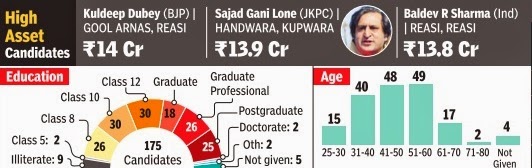
Homeshalibung in south Kashmir witnessed the lowest turnout -36.50%. A turnout of 71% was recorded in the first phase of polling last week. Ghulam Hassan Dar, a 52-year-old Homeshalibugh farmer, blamed broken promises for the low turnout. “We are fedup with polling now. Politicians come, promise and leave for six years. Besides, our youth are influenced by separatism.“ The mood is north Kashmir was different, where Abdul Rahman War of Handwara said voters flocked to polling booths despite freezing weather. “Voters could not come out of their homes before 8 am. But started doing so as the day progressed,'' he said, add ing that they voted for change and hoped the new government would not break promises. Ex-separatist Sajad Lone is contesting from Handwara, where he is up against ruling National Conference's Chowdary Ramzan. He said he was optimistic about his win. “I congratulate people for showing wisdom and voting out NC and PDP candidates,'' he said.
He assured his People's Conference would work for the area's development. “I congratulate my workers for a victory , which by all indications is ours.“

Agni-IV test-fired


India's dissuasive nuclear deterrence against China got a tad more credibility with the country testing the Agni-IV ballistic missile, which has a strike range of 4,000-km, from the Wheeler Island off Odisha coast on Tuesday . The Agni-IV was tested in “its full deliverable configuration“ by the tri-service Strategic Forces Command (SFC) in the first-such user trials, after one failed and three successful “developmental trials“ over the past four years. The operational induction of the missile, which was tested for a range of only 3,000 km on Tuesday , will take another couple of years. DRDO scientists said there were no glitches during the missile's entire parabolic flight path, which was constantly monitored by long-range radars and electrooptical systems all along the coast, till its splash point in the Bay of Bengal.
More fireworks are shortly expected over the Indian Ocean with the DRDO gearing up for the third developmental test of the 5,000-km Agni-V , the country's first true intercontinental ballistic missile, in a month or so. The three-stage Agni-V is likely to be inducted by 2017. The SFC has already inducted the short and intermediate range Prithvi and Agni missiles geared towards Pakistan, which has overtaken India both in terms of missiles and nuclear warheads with covert help from China and North Korea over the years.
The road-mobile Agni-IV and Agni-V , in turn, are specifically meant for deterrence against China, which can target any Indian city with its formidable inventory of missiles. Importantly , the Agni-V is now slated to be tested in its canister version, which will give the armed forces the operational flexibility to rapidly transport and fire it from anywhere they want.
“With Prithvi and Agni-I, II, III missiles already in the arsenal, Agni-IV enhances India's reach and effective deterrence capability . Agni-IV is equipped with state-of-the-art avionics, 5th generation on-board computer and distributed architecture,“ said the DRDO. Scientists are developing “manoeuvering warheads or intelligent re-entry vehicles“ to defeat enemy missile defence systems as well as MIRVs (multiple independently targetable re-entry vehicles) for the Agni series. A single missile with a MIRV payload can deliver multiple nuclear warheads to different targets.