15.8.22

System needs a complete tune-up, says CJI-designate


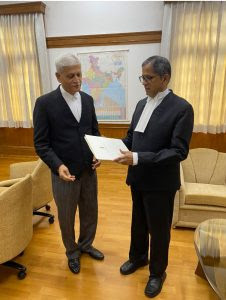
CJI-designate UU Lalit pointed out that justice eludes victims of triple talaq years after a law was brought in against the practice. “Take for example today’s news item saying even after five years, the victims are not getting justice. There has to be a throbbing system. ”

“Look at the civil side. Fruits of decree, got after years of litigation, eludes the decree-holder. There the system needs complete tuneup or complete revamp. We may lay down law. But, in the actual dispensation, what happens is there are many misses between the cup and the lip . On the positive side, the law which is getting laid down by the S C is of the highest order,” he said.

Asked why the SC repeatedly rules and espouses the right to equality for women and giving them their due, yet not facilitating appointment of adequate number of them as judges of the constitutional courts, the CJI-designate said the scenario would undergo a complete change in the next 10-15 years. “The number of women judges in the trial courts has risen substantially. For example, in Rajasthan, of the 190 candidates who underwent an induction programme as trial court judges recently, 129 were women. Similar is the story in Odisha and other states. These women judges would surely rise and become eligible for high court judgeship in 10-15 years,” he said.

Of the few women judges appointed to the SC, Justice Lalit said if one looks at the talent pool available for selection to the SC, say the 100 most senior HC judges, there are only few women among them. “So it would not be possible to select them, without their acquiring requisite seniority. But I’m very sure the scenario will undergo fast paced change in the next decade or half,” he said. There has been a lot of talk in the courtroom, especially when a SC judge retires, that given the rise in life expectancy level and the fitness of judges, their retirement age should be increased to 70 years. Attorney general K K Venugopal is a votary of increase in the S C judges’ retirement age. CJI-designate Lalit said whatever is the retirement age for judges, it should be identical for the SC and HC. At present, SC judges retire at 65 and HC judges at 62.

“Personally speaking, 65 is the appropriate age for retirement of a judge. We work under so much pressure. ”

“It is true life expectancy has increased and there is logic behind using the tried and tested pool of talent that ha s served the country well. But, if you increase the age limit, then it will block the chances of youngsters. That is equally good talent. So, if you increase the age of judges, then the sanctioned strength of the courts should also increase,” he said.

Dam wall collapses in MP


A portion of Karam dam in MP’s Dhar collapsed on Sunday evening as a channel dug to drain water from the reservoir widened under pressure of the surging water. Thankfully, there were no casualties as around 10,000 people from 18 downstream villages had been evacuated. Chief minister Shivraj Singh Chouhan issued a video statement to say that all is well and the danger has been averted. “You can return home in coordination with the administration and celebrate Azadi Ka Amrit Mahotsav in your villages,” he told the thousands living in relief camps.

Barely a couple of hours before this, the CM had tweeted a video urging villagers, with folded hands, not to return to the villages. The administration and villagers were on edge all evening as no one could predict which way the dam water would surge.

The administration sought to portray that everything that happened was part of the plan. Divisional commissioner Pawan Sharma said that water hadn’t even entered the evacuated villages whereas there are videos and eyewitness accounts of water entering villages and temples submerged.

“For a while we were shaken,” the CM acknowledged, adding: “Now, there is no danger. ” Around 10pm, the water reached the last affected village of Jalkota in Khargone district and started merging with the Narmada river after which the administration breathed a sigh of relief. The CM spoke with villagers of Jal Kota over phone. 

Water resources minister Tulsiram Silawat has set up a five-member committee to probe the construction. A Delhi-based firm was building the Rs 304-crore dam. The breach in the dam was noticed on Thursday afternoon, sparking panic in nearby areas and alarm in the administration. After government engineers failed to plug the leak, the Army was called in and around 200 soldiers began working in the wee hours of Saturday to prevent collateral damage. On Saturday, Chouhan spoke with PM Narendra Modi and home minister Amit Shah and requested to have two IAF choppers on standby.

A channel was dug to release water into Namcha river and on to the Narmada.

It’s this channel that widened around 6pm on Sunday evening, sending torrents of water surging downstream.

Eyewitnesses said that floodwaters touched the brim of a four-lane bridge on Agra-Mumbai national highway barely 30 minutes later. For a while it seemed as if the bridge would be overwhelmed but the water stayed just below it.

Traffic was stopped on the highway across a 30km stretch and an alert sounded in riverside villages near the temple town of Maheshwar, 50km away, where the dam water flowed into the Narmada.

There was no report of loss of life till this report was filed. Ravi Solanki, an eyewitness of the submergence of Kothira, Imlipura and Dugni villages, said that all three hamlets and standing crops all around went under water. An alert was sounded in villages in Khargone and near Maheshwar.


Gadkari speak on toll booths

Going ahead with plans to do away with toll plazas in the country, Union minister Nitin Gadkari said all old vehicles too would be fitted with new number plates that can be directly monitored through satellite using GPS and a sophisticated system. “The use of tamper-proof high security registration plates for new vehicles was started from 2019, where government agencies can get information about vehicles. Now, we have decided to provide the plates to old vehicles too. Currently, you need to pay full charges at toll plazas even 60km away from each other. Now, if you use the highway for only 30km, you will be charged half the price, with the help of new technology. ”

Stressing that this new initiative was still in the planning stages, the transportation minister said the Centre was sure of making the country free of toll plazas soon. “There will be no stoppages for vehicles and therefore, there will be less pollution, and it would also save time. With new technology, the money could be directly deducted from bank accounts. About 97% vehicles in India are on Fast-tag. The Indian road infrastructure would be at par with that in the United States before 2024 Lok Sabha polls. ”

On plans to launch liquid hydrogen as an alternative fuel, Gadkari said they had envisaged a Rs.17,000 crore project to generate green, black and brown hydrogen. “The green hydrogen would be generated from water and biomass. In municipal corporations, organic waste is generated in the form of sewage. If we treat this wastewater by using solar power, to generate hydrogen, it will benefit all. We can produce ethanol from organic waste by segregating it, which could be used to run generators. I am using a generator purely on ethanol, and its cost is only Rs.60 per litre against Rs.110 per litre of diesel. ”

Explaining new aluminum air technology, he said, it has been developed at Faridabad. “We are developing lithium ion, zinc ion and aluminium ion to make cost-effective batteries. This will lead to many changes in electric vehicles. We are starting buses and trucks running on methanol in Assam shortly. CNG and LNG costs are higher due to the Russia-Ukraine war, but these will reduce. We need to develop technologies which can substitute import, and are cheaper and pollution free. ”

14.8.22

‘India Could be 2nd Most Important Driver of Global Growth after China’


India is likely to be the second most important driver of global growth in 2022 after China despite the challenges posed by the pandemic and the war in Europe, Reserve Bank of India’s deputy governor, Michael D Patra, said.

The world’s third-largest economy in terms of purchasing power parity is going to contribute about 14% of global growth this year, he said, even while the country faces the risk of rising deficit due to higher import bills on the back of global commodity prices. Patra said India can sustain a current account deficit of 2. 5-3% without getting into an external sector crisis. “A striking feature in India is that our growth is home financed – investment is financed primarily by domestic savings, with foreign savings playing only a supplemental role,” Patra said Saturday.

Even though the savings rate slowed since 2007-08 after the global financial crisis, eventually pulling down the investment rate which has exhibited deceleration since 2012-13. “Reversing this trend is critical to achieve higher growth,” Patra said in an event to celebrate Azadi Ka Amrit Mahotsav organised by RBI's Bhubaneswar office.

India at present is the third largest economy in the world in terms of purchasing power parity with a share of 7% of global GDP, after China's 18% and the US's 16%. India’s GDP in market exchange rates is expected to reach $5 trillion by 2027. By that year, India’s GDP in purchasing power parity terms will exceed $16 trillion, up from $10 trillion in 2021. He said India can achieve a double digit growth in the next decade if the economy can overcome challenges and capitalises on the world’s youngest workforce it has, along with manufacturing and export promotion, This would make India the second largest economy in the world by 2031, he said.

“It’s possible to imagine India striking out into the next decade with a growth rate of 11%. If this is achieved, India will be the second largest economy in the world not by 2048 as shown earlier, but by 2031,” Patra said. “Even if it does not sustain this pace and slows to 4-5% in 2040-50, it will become the largest economy of the world by 2060,” he said.

11 more wetlands get global tag of importance


India’s 11 more wetlands got a tag of international importance under the Ramsar Convention — an inter-governmental global treaty to preserve the ecological character of selected wetlands across the globe — bringing the total number of such sites in the country to 75. The new addition has put India at the top in terms of having the highest number of Ramsar sites among Asian countries, surpassing China’s 64. The new sites, covering an area of 76,316 hectares, include four in Tamil Nadu (Chitrangudi Bird Sanctuary, Suchindram Theroor Wetland Complex, Vaduvur Bird Sanctuary and Kanjirankulam Bird Sanctuary); three in Odisha (Hirakud Reservoir, Tampara Lake and Ansupa Lake); two in Jammu & Kashmir (Shallbugh Wetland and Hygam Wetland; and one each in Madhya Pradesh (Yashwant Sagar) and Maharashtra (Thane Creek).

Hirakud Reservoir with 65,400 hectares is the biggest in the list of 11. Among states, Tamil Nadu has the maximum number of Ramsar sites (14), followed by Uttar Pradesh (10), in the list of 75. “We became a contracting party to the Ramsar Convention in 1982. From 1982-2013, only 26 sites were added to the list of Ramsar sites. From 2014-2022, we added 49 new wetlands to the list,” tweeted environment minister

Bhupender Yadav on Saturday just two days ahead of completion of 75 years of independence.

The wetlands — land areas covered by water, either seasonally or permanently — play a key role in flood control and as sources of water, food, fibre and raw materials. Besides, such land areas also support mangroves that protect coastlines and filter pollutants.


Punjab OKs ‘One MLA, One Pension’

Punjab governor Banwarilal Purohit gave his assent to the “One MLA, One Pension” bill, following which a gazette notification was issued by the Bhagwant Mann government.

“I am very happy to inform Punjabis that the Hon’ble Governor has approved the ‘One MLA One Pension’ Bill… Govt has issued a notification. This will save a lot of tax for the public,” chief minister Bhagwant Mann tweeted on Saturday.

Finance minister Harpal Singh Cheema added, “No more ‘Free ki Revdi’ to Netas! When Punjab was reeling from extreme financial distress, MLAs under the previous govts (enjoyed) multiple pensions. Under the leadership of CM Bhagwant Mann, this (ends). One MLA one pension will save approx Rs 19.53 crore (sic). ”

Mann added in a statement that Punjab expects to save around Rs 100 crore during its five-year tenure. “During the last 75 years, these elected representatives have turned into political executives by drawing extravagant salaries and pensions from the state exchequer. The entire burden of this facility extended to these leaders was met by taxpayers. Their money was misused to fill the pockets of these leaders instead of being used for public welfare,” he said.

The notification was issued on August 11 by the department of legal and legislative affairs. “This Act may be called the Punjab State Legislature Members (Pension and Medical Facilities Regulation) Amendment Act, 2022. It shall come into force on and with effect from the date of its publication in the official gazette,” it read. As per the amendment, a former MLA will get a pension for only one term.


13.8.22

Passenger Vehicle Sales Surge as Chip Woes Ease


Passenger vehicle sales last month increased in double digits, as easing constraints on component supplies allowed manufacturers to step up production of cars and utility vehicles even as their order backlog continued to swell.

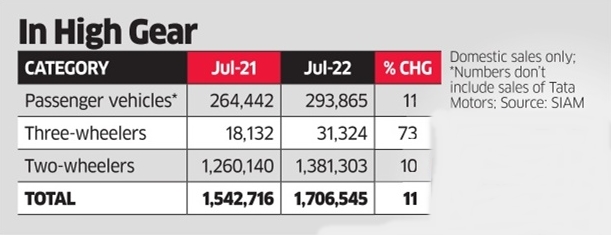
As per data available with industry body Society of Indian Automobile Manufacturers, 293,865 passenger vehicles were sold last month, marking an increase of 11% compared with a year earlier. The growth would be even higher at 16% (341,370 units) if the volume of Tata Motors too is included. The manufacturer of the Tata Harrier SUV, which dispatched 47,505 units in July, has stopped reporting monthly numbers to SIAM. PV sales had previously peaked at 334,000 units, including of Tata Motors, in October 2020.

Automakers in India mostly report wholesale dispatches from factories to dealers and not retail sales to customers.

Senior industry executives are upbeat about the growth prospects in the passenger vehicle segment in the upcoming festive period and are working overtime to build inventory to hasten deliveries.

In the two-wheeler segment, sales rose 10% to 1,381,303 units, albeit on a low base. While sales of motorcycles increased 4% to 870,028 units, those of scooters went up 28% to 479,159 units. Weak consumer sentiment at the lower end of the market, however, kept the industry worries.

Three-wheeler sales grew 73% to 31,324 units in the past month from a year earlier. Sales of two-wheelers last month were below the July 2016 numbers, and those of three-wheelers less than the volume in July 2006, said SIAM.

The country’s largest two-wheeler maker, Hero MotoCorp, expects normal monsoon in most parts of the country, the consequent agricultural harvest along with the upcoming festive season to keep the sentiment positive and help build the momentum going ahead. Ravi Bhatia, president at automotive consultancy firm Jato Dynamics, said while improved supplies of semiconductors, restocking of dealers, large order backlog and resilient customer spending would boost growth in the passenger vehicle segment, risks remained due to macroeconomic challenges.

Sales across the various categories (passenger vehicles, two-wheelers and three-wheelers) rose as much as 11% to about 1,706,545 units in July.